
Why Cold-Weather Sites Need an Anti-Freeze Emergency Shower
A safety shower only earns its place on a site if it works the moment someone needs it. In sub-zero conditions, a conventional unit fails in the worst possible way: standing water inside the riser turns to ice, the valve seizes, and the first person exposed to a corrosive chemical gets nothing but a frozen pipe. An anti-freeze emergency shower solves that problem mechanically. Water is held below the frost line and the exposed pipework empties automatically after every use, so there is never a column of water sitting in the riser waiting to freeze.
This unit pairs that self-draining design with a full ANSI-compliant combination fixture — an overhead drench shower and a twin-nozzle eye/face wash — mounted on a single stainless steel column with a high-visibility yellow and black safety stripe. It is built for refineries, chemical plants, mining sites, fertiliser and battery production, LNG terminals, and any outdoor process area where winter temperatures regularly drop below freezing.
How the Auto-Emptying System Works
The heart of the design is a self-draining valve located below grade. When the shower or eyewash is activated, the valve opens and water rises through the riser to the fixtures. When the user releases the handle or steps off the pedal, the valve closes at the supply side and simultaneously opens a drain port. Gravity does the rest: every drop above the frost line is evacuated through the NPT 1 1/4″ drain within seconds.
Because there is no residual water above ground, the system needs no electric heat tracing, no insulation jacket, no steam tracing and no glycol loop. That removes the recurring cost and the single biggest failure point of heated safety showers — a tripped breaker or a failed heat-trace circuit that nobody notices until an emergency. Maintenance is limited to the weekly activation test that ANSI Z358.1 requires anyway, and the weekly test itself confirms the drain is clear.
Hands-Free Activation, Including a Foot Pedal
Anyone reaching a safety shower after a chemical splash may have compromised vision or contaminated gloves. This station is designed so that activation takes no thought and no grip. A pull rod with a triangular handle activates the overhead drench shower and stays open until it is manually reset, leaving both hands free for the full 15-minute flush that ANSI Z358.1 specifies. The eye/face wash is opened by a push-flag handle on the bowl, and an optional stainless steel foot pedal lets a user start the eyewash by stepping on it — useful when hands are injured, chemically contaminated, or occupied holding eyelids open.
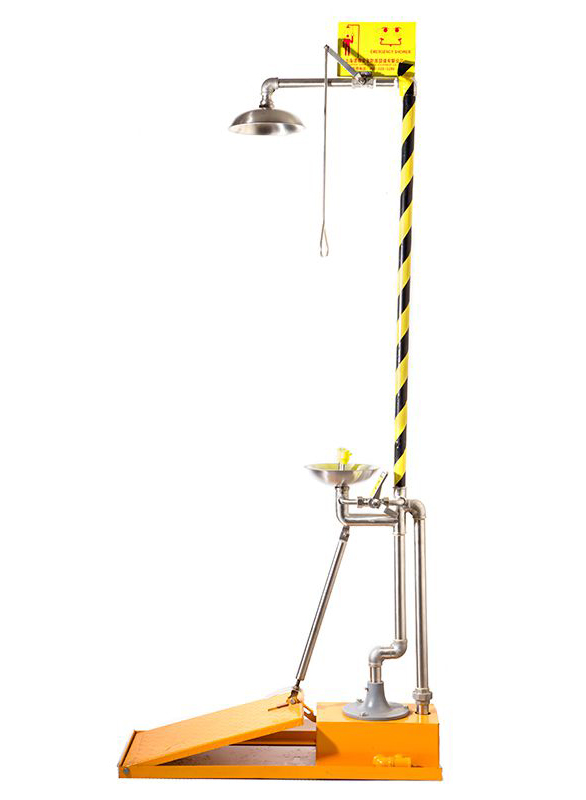
The orange base platform with its ramped approach keeps the user positioned correctly under the shower head and makes the station easy to spot across a busy yard.
Technical Specifications
| Parameter | Specification |
|---|---|
| Compliance | ANSI Z358.1-2014, EN15154-1/2:2006 |
| Material | 304 / 316L stainless steel |
| Overall height | 2410 mm (customisable) |
| Pipe wall thickness | 2.5 mm |
| Operating water pressure | 0.2 MPa – 0.8 MPa |
| Ambient temperature range | 0 °C – 55 °C |
| Inlet connection | NPT 1 1/4″ |
| Drain connection | NPT 1 1/4″ |
| Eye/face wash flow rate | ≥ 11.4 L/min |
| Drench shower flow rate | ≥ 75.7 L/min |
| Shower head & bowl material | ABS or stainless steel |
| Eyewash assembly | SUS304 pipe (1-1/4″), ball valve, bowl with dust cover |
| Spray nozzles | Stainless steel with built-in PP filter |
| Options | Colour, material, dimensions, stainless steel foot pedal |
Those two flow figures are not arbitrary. ANSI Z358.1 sets a minimum of 0.4 GPM (1.5 L/min) for eyewash units and 20 GPM (75.7 L/min) for drench showers; the ≥11.4 L/min delivered here comfortably exceeds the eye/face wash requirement, giving a full-face flushing pattern rather than a narrow jet.
Materials Built for Corrosive Environments
The complete wetted path — riser, eyewash arm, valve bodies and nozzles — is 304 or 316L stainless steel. Specify 316L where the atmosphere carries chlorides or acid mist, such as coastal installations, pickling lines, chlor-alkali plants and fertiliser handling. The 2.5 mm pipe wall gives the column the rigidity to survive knocks from passing equipment, and the stainless nozzles carry an integral PP filter that traps scale and sediment so the flushing pattern stays symmetrical over years of service. A dust cover keeps the eyewash bowl clean between uses and lifts away automatically under water pressure.
Where It Fits: Outdoor and Hazardous Areas
Because the unit relies on gravity draining rather than electrical heating, it introduces no ignition source and needs no ATEX-rated wiring, which makes it straightforward to place in classified hazardous zones. Typical positions include tank farms, drumming and decanting stations, acid unloading bays, sample points, and battery limits where a 10-second, unobstructed travel path from the hazard is required by ANSI Z358.1.
Installation is simple: a below-frost-line supply of clean potable water at 0.2–0.8 MPa, an NPT 1 1/4″ drain to a sump or soakaway, and a level concrete pad to anchor the base. Height, colour and material can all be customised to match site standards.
Specify With Confidence
An anti-freeze emergency shower is one of the few pieces of site equipment that must perform perfectly on its first and only use. A self-draining valve, stainless steel construction, hands-free and foot-pedal activation, and certified ANSI Z358.1 and EN15154 flow performance together mean this station is ready in January exactly as it is in July.