
Two Barriers Against Corrosion, One Compliant Fixture
Most emergency showers fail long before they are ever needed. They corrode quietly for five years in a fume-laden workshop, and the first thing a splash victim receives is discoloured water from a pitted riser — or a seized valve that will not open at all.
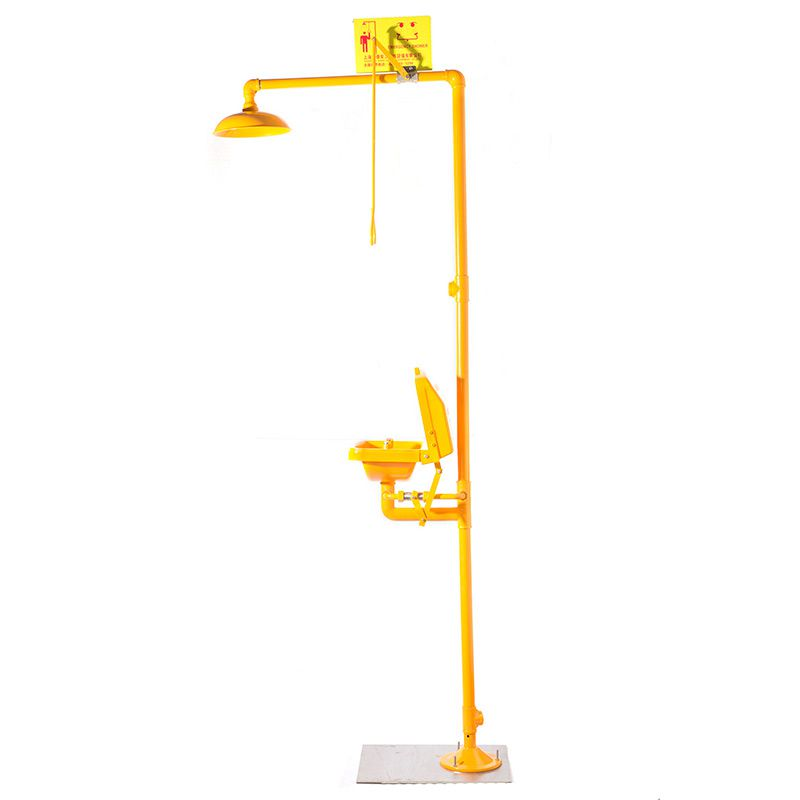
The DAAO6613-D takes a two-layer approach to that problem. The structure is stainless steel 304 (with SS316L available as an option), and over it sits a factory-applied ABS coating in high-visibility yellow. The stainless core resists internal corrosion from the water it carries; the ABS jacket shields the exterior from acid mist, alkaline aerosols, salt air, UV and mechanical abrasion. Neither layer depends on the other, so surface damage from a passing forklift does not expose bare carbon steel — it exposes stainless steel.
The result is a compound shower and eyewash that stays serviceable in exactly the environments that destroy painted and galvanised equipment: plating shops, pickling lines, battery rooms, fertiliser plants, pulp bleaching, chemical warehouses and coastal terminals.
Visibility Is a Safety Feature, Not a Colour Choice
A worker with chemical in their eyes is, functionally, partially blind. They will be moving toward a shape and a colour they memorised during induction, not reading signage.
The saturated safety yellow of the DAAO6613-D is engineered around that reality. It reads clearly against grey concrete, stainless plant, dark machinery and low light, and unlike paint it does not chalk, flake or fade under sustained UV exposure — a coated unit installed outdoors looks the same in year eight as in year one. The bilingual instruction placard mounted at eye level on the riser reinforces the fixture’s identity from a distance.
ANSI Z358.1 requires emergency equipment to be highly visible and clearly identified. A permanently coloured, non-degrading finish satisfies that clause for the life of the asset rather than until the next repaint cycle.
Technical Specifications
| Parameter | Specification |
|---|---|
| Model | DAAO6613-D |
| Overall height | 2410 mm |
| Material | Stainless steel 304 (SS316L optional) + ABS coating |
| Certification | ANSI Z358.1-2014, EN15154-1/2:2006 |
| Pipe wall thickness | 2.5 – 3 mm |
| Functions | Eye washing + body showering |
| Working pressure | 0.2 MPa – 0.6 MPa |
| Working environment temperature | 10 °C – 35 °C |
| Inlet connection | NPT 1 1/4″ |
| Drain connection | NPT 1 1/4″ |
| Shower head diameter | 10″ / 26 cm |
| Eyewash bowl diameter | 10″ / 26 cm |
| Eyewash flow rate | ≥ 11.4 L/min |
| Shower flow rate | ≥ 75.7 L/min |
Certified Flow, Verified Against the Standard
Specification sheets are easy to write; flow rates are the numbers an auditor actually checks. The DAAO6613-D is built and tested to ANSI Z358.1-2014 and EN15154-1/2:2006.
The overhead drench shower delivers ≥ 75.7 L/min — 20 GPM, precisely the ANSI minimum for a plumbed shower, spread across a 10-inch (26 cm) dished head so the pattern covers both shoulders and the full torso instead of concentrating on the crown of the head. The eyewash delivers ≥ 11.4 L/min (3 GPM) through twin heads over a 10-inch bowl — roughly seven times the 1.5 L/min ANSI floor — giving a soft, high-volume flush that irrigates the eye without driving contaminants deeper.
Both are engineered to hold those rates for the full 15-minute flush the standard mandates, on a supply of 0.2–0.6 MPa. Our compliance engineering team can map these figures against the specific standard set your project is audited to.
Hands-Free Operation Under Real Conditions
Activation must work for someone who cannot see and may not be able to grip.
The shower opens via a pull rod with a triangular handle, reachable with a forearm, elbow or wrist. The valve is stay-open: pull once and water continues to flow until it is deliberately reset, so nobody has to maintain pressure on a handle for fifteen minutes while in pain. The eyewash opens with a push-flag handle at the bowl — one motion, no grip strength, no fine motor control required.
A dust cover sits over the twin spray heads and is displaced by the first surge of water, keeping airborne dust, insects and debris out of the nozzles between uses. The unit stands on a square floor flange for bolting to a level pad, with an NPT 1 1/4″ inlet and an NPT 1 1/4″ drain so bowl overflow can be piped to a sump or containment rather than pooling around the casualty’s feet.
Installation and Maintenance
Site the unit within 10 seconds’ unobstructed travel of the hazard — around 15 metres — on the same level, with no doors, steps or stored materials in the path, and with clear lighting. Confirm supply pressure sits inside the 0.2–0.6 MPa band and that the water is potable and tepid, which ANSI defines as 16–38 °C.
Note the stated working environment range of 10 °C to 35 °C. Where winter temperatures fall below freezing, this model should be replaced by a self-draining unit such as the DAAO6615 anti-freeze station; where no reliable water main exists, specify a 1500 L tank-fed enclosure instead.
Maintenance follows the standard: activate weekly to flush the line and exercise the valves, and complete a full performance inspection annually.
Specify the DAAO6613-D
If your hazard is corrosive and your environment is aggressive, the coated compound station is the durable choice. Where a bare stainless finish is preferred, the DAAO6610 offers the same certified performance in polished 304.