
Freeze Protection Without a Single Watt of Power
Heat tracing is the default answer to winter, and it carries a permanent liability: it can fail silently. A tripped breaker, a chafed heating cable or a failed thermostat leaves a shower that looks perfectly serviceable and is, in fact, a column of ice. Nobody finds out until someone pulls the handle.
The DAAO6615-D takes the mechanical route instead. A self-draining valve located below the frost line opens the supply when the unit is activated and, the moment it is closed, opens a drain port that empties every millimetre of exposed pipework by gravity through the NPT 1-1/4″ drain outlet. With no standing water above ground, there is nothing left to freeze — no cable, no thermostat, no circuit, no failure mode.
That is why the unit carries a working environment range of 0 °C to 55 °C: it is equally valid for Siberian winters and desert summers, and it needs no electrical supply whatsoever to deliver its core protection.
What the Cover Lid Actually Prevents
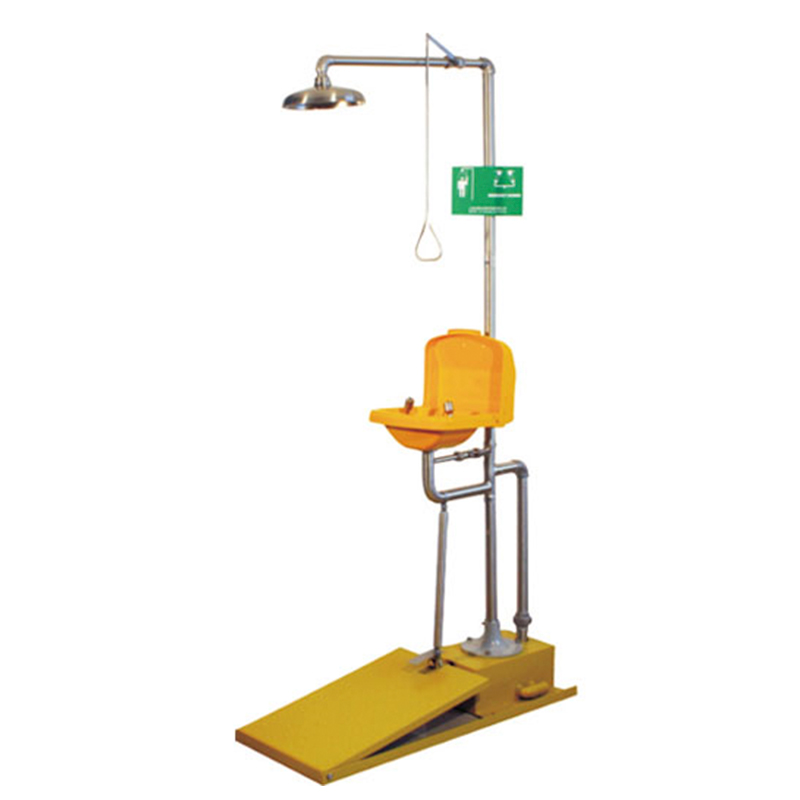
The hinged cover lid over the eyewash bowl looks like a minor accessory. In service, it is the component that keeps the unit compliant between tests.
An uncovered eyewash bowl mounted outdoors is a collection tray. It gathers airborne process dust, grit, insects, bird droppings, leaves and — in a chemical plant — the very aerosols the shower exists to wash off. All of that concentrates in the bowl and around the nozzle heads. The first flush after an incident then delivers that contamination straight into an already injured eye, at pressure.
The lid seals the bowl and the twin spray heads against all of it, and lifts clear automatically under the first surge of water so it never delays activation. In dusty environments — cement, mining, fertiliser handling, dry bulk transfer — it is the difference between a fixture that stays clean for a year and one that needs cleaning every week.
Technical Specifications
| Parameter | Specification |
|---|---|
| Model | DAAO6615-D |
| Certification | ANSI Z358.1-2014, EN15154-1/2:2006 |
| Material | AISI 304 SS (AISI 316L optional) + carbon steel / ABS coating |
| Shower flow rate | ≥ 75.7 L/min |
| Eyewash flow rate | ≥ 11.4 L/min |
| Pipe thickness | 2.5 / 3 mm |
| Working pressure | 0.2 – 0.6 MPa (2 – 6 bar) |
| Water inlet | NPT 1-1/4″ |
| Drain outlet | NPT 1-1/4″ |
| Working environment temperature | 0 °C – 55 °C |
| Mounting | Floor / base mounted |
| Activation | Pull rod (shower), push flag (eyewash), optional stainless steel foot pedal |
Optional packages: local audible & visual alarm, DCS / PLC signal interface, wireless remote alarm, inlet booster pump, drainage pump, hazardous-area electrical package.
Certified Flow, Held for the Full Fifteen Minutes
The drench shower delivers ≥ 75.7 L/min — 20 GPM, the ANSI Z358.1 minimum for a plumbed shower. The eyewash delivers ≥ 11.4 L/min (3 GPM) through twin heads, roughly seven times the 1.5 L/min ANSI floor, producing a broad, low-velocity flushing pattern that irrigates the eye instead of driving contaminants deeper.
Both rates are engineered to hold for the full 15-minute flush on a supply of 0.2–0.6 MPa (2–6 bar). Our compliance engineering team can verify these figures against the standard set your project is audited to.
Turning a Fixture Into a Monitored Asset
A safety shower in a remote tank farm may be activated by a lone worker who cannot see, cannot use a radio, and cannot walk back for help. The optional signalling packages exist for exactly that scenario:
- Local audible & visual alarm — a sounder and beacon that fire the instant the valve opens, alerting anyone within sight or earshot.
- DCS / PLC signal interface — a dry contact or signal output to the control room, so operators see the activation in real time, log it, and dispatch a response. It also creates the timestamped incident record HSE reporting requires.
- Wireless remote alarm — the same supervision where cable routing is impractical or a temporary installation makes hard wiring uneconomic.
- Hazardous-area electrical package — where the shower sits in a classified zone, alarms and instrumentation are supplied as certified equipment engineered to the project’s zone, gas group and temperature class.
Solving Marginal Site Hydraulics
Two pump options address the conditions that most often derail an emergency shower installation.
Inlet booster pump. If the available supply cannot hold 0.2 MPa while delivering 75.7 L/min, the shower will not meet ANSI flow at the head — a common finding at the end of long service mains or on elevated platforms. A booster pump guarantees the duty point rather than leaving it to hope.
Drainage pump. The self-draining principle depends on somewhere for the water to go. Where there is no gravity fall to a sump — a below-grade bay, a bunded area, a slab with no fall — a drainage pump evacuates the riser and the discharged flush water so the anti-freeze function still works and contaminated effluent is routed to containment.
Hands-Free Activation and Materials
The shower opens with a pull rod operable by forearm or elbow and stays open until deliberately reset. The eyewash opens with a push flag, and the optional stainless steel foot pedal allows activation by foot when hands are injured, gloved with contaminant, or busy holding eyelids open.
The wetted path is AISI 304 stainless steel, with AISI 316L advised for chloride-rich, marine or acidic atmospheres. The carbon steel / ABS coated construction offers a high-visibility, chemical-resistant exterior at project-friendly cost, and the 2.5 / 3 mm pipe wall withstands mechanical knocks in traffic areas. The unit is floor / base mounted on a level pad.
Specify the DAAO6615-D
Where winter is the risk and electrical heating is a liability you would rather not own, a self-draining station is the robust answer. Compare it with the base DAAO6615, the heat-traced DAAO6620-DF, or the heated tank-fed enclosure for extreme-cold sites — the full range is in Freeze-Protected Systems.